
Retinol, Acids, Vitamin C, Niacinamide: What Not to Mix
Retinol, glycolic acid, salicylic acid, vitamin C and niacinamide are some of the most talked-about skincare ingredients, and also the source of a lot of confusing advice. Some of the “never mix” rules online are based on real irritation risk. Others come from old studies that don’t reflect modern formulas.
The short answer: the main pairings to approach with care are retinoids with exfoliating acids (AHA/BHA), and several strong exfoliants at once, because together they can increase irritation. Vitamin C and niacinamide can generally be used together. And anything that makes skin more sun-sensitive, especially retinoids and AHAs, makes daily sunscreen essential.
Why combining actives can cause trouble
Most “don’t mix” advice is really about irritation, not a dangerous chemical reaction. Retinoids and exfoliating acids both increase skin turnover and can temporarily weaken the skin barrier. Use them together and the effects can add up: redness, stinging, flaking, tightness. A secondary concern is that some ingredients work best at a particular pH, and layering can make a formula less effective. The practical solution is usually to separate them by time of day or by night.
Retinol + AHA/BHA: alternate rather than layer
Retinoids (retinol, retinal, and prescription forms such as tretinoin or adapalene) and exfoliating acids (glycolic, lactic and mandelic acid, salicylic acid) are the pairing most commonly flagged by dermatologists as irritating when used at the same time, particularly for beginners or sensitive skin.
- A common approach: retinoid on some nights, acid on others, with “rest” nights of just moisturizer in between
- Don’t start both in the same week; introduce one, wait until your skin tolerates it, then consider the other
- If you use a prescription retinoid, ask your prescriber before adding any exfoliating acid
- Some products are formulated to combine both. Use them as the label directs, not layered with more actives
Retinoids + benzoyl peroxide
Benzoyl peroxide can break down some forms of tretinoin when they’re applied together, which is why such products have traditionally been used at different times of day. Adapalene, on the other hand, is sold combined with benzoyl peroxide in some formulas. Because the answer depends on the exact products, this is a question for your doctor or pharmacist, and the product labels.
Vitamin C + AHA/BHA
Pure vitamin C (L-ascorbic acid) serums are typically acidic, and so are exfoliating acids. Layering them can be too much for some people. A simple split: vitamin C in the morning, exfoliating acid in the evening on the nights you use it.
Vitamin C + retinol
These aren’t chemically incompatible, but both can be irritating at higher strengths. The common routine is vitamin C in the morning under sunscreen, and retinoid at night. That also plays to their strengths: an antioxidant during the day, a light-sensitive retinoid at night.
Vitamin C + niacinamide: the myth
You may have read that vitamin C and niacinamide “cancel each other out” or turn into something irritating. That idea traces back to older research using different forms of the ingredients under conditions, such as heat, that don’t match how modern skincare is made or used. Many dermatologists today consider the two fine to use together, and some products contain both. If your skin feels fine, there’s no need to separate them. If you notice flushing or stinging, try them at different times of day.
Niacinamide: the easy one
Niacinamide is generally well tolerated and commonly paired with retinoids, acids, hyaluronic acid and sunscreen. That doesn’t mean everyone tolerates it at every strength: some people find high concentrations irritating. Start with what the label recommends.
Too many exfoliants at once
An acid toner, an acid serum, a scrub and a peel mask in one routine is a common route to an over-exfoliated, sensitive face. Choose one exfoliating product and use it as directed. Signs you’re overdoing it include stinging when you apply normally gentle products, persistent redness, tightness, shiny-looking skin or flaking. If that happens, stop the actives and stick to a gentle cleanser, moisturizer and sunscreen; see a professional if it doesn’t settle.
Sunscreen with retinoids and acids
Retinoids and AHAs can increase skin’s sensitivity to the sun. In the US, cosmetics containing AHAs are recommended to carry a sunburn alert telling you to use sunscreen while using the product and for a week afterwards. In practice:
- Use a broad-spectrum sunscreen, SPF 30 or higher, every morning while using these actives
- Reapply when you’re outdoors for long periods, after swimming or sweating, as the label directs
- Use retinoids at night unless your product says otherwise
- Take extra care before a beach trip or ski holiday; consider pausing strong exfoliants beforehand
A simple way to schedule actives
One example week for someone using a retinoid and an AHA who tolerates both (adjust to your own skin and your dermatologist’s advice):
- Every morning: gentle cleanser, vitamin C or niacinamide serum, moisturizer, sunscreen
- Monday, Thursday: retinoid at night, then moisturizer
- Tuesday: AHA or BHA at night, then moisturizer
- Other nights: cleanser and moisturizer only
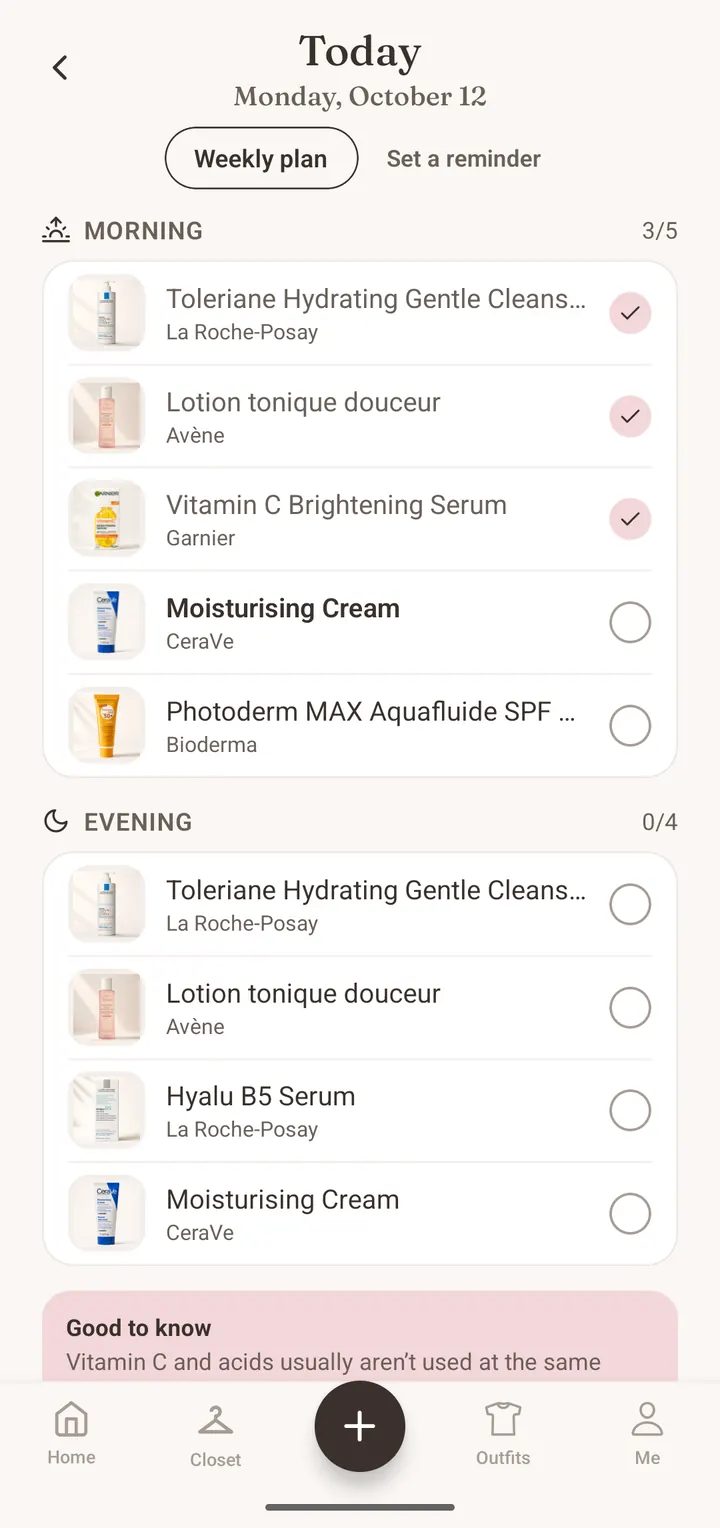
Writing this down helps more than remembering it. In Closie Plus, Skincare lets you set how often you use each product, and the weekly plan spreads exfoliants and masks across different days, with short, plain-language notes about common pairings. It’s not a medical device and doesn’t replace a dermatologist; it just keeps your own plan visible.
Skincare routine order: morning and night, step by step →
Can I use vitamin C and niacinamide together?
Generally yes. The idea that they cancel each other out comes from older research that doesn’t reflect modern formulas. If your skin flushes or stings, use them at different times of day.
Can I use retinol and salicylic acid together?
Many people find the combination irritating, so alternating them on different nights is a common approach. If you want to use both at once, ask a dermatologist first.
Can I use retinol in the morning?
Retinoids are usually recommended for night use because they can make skin more sun-sensitive and some degrade in light. Follow your product’s label.
Do I need sunscreen if I use AHAs or retinol?
Yes. Both can increase sun sensitivity, so daily broad-spectrum sunscreen of SPF 30 or higher is strongly recommended while you use them.
Can I use retinol while pregnant?
Retinoids are generally not recommended during pregnancy. If you’re pregnant, trying to conceive or breastfeeding, ask your doctor before using any active ingredient.
How the Closie skincare routine app plans your morning and night →
Plan which actives you use on which day with Closie Plus
Get Closie Plus