
Skincare Routine Order: Morning and Night, Step by Step
Most people don’t need more skincare products. They need the ones they already own in a sensible order. Put a heavy cream under a watery serum and the serum barely reaches your skin; put sunscreen anywhere but last in the morning and you dilute the one step that protects you. The order matters more than the brand.
The short answer: apply products from thinnest to thickest. In the morning that means cleanser, toner (optional), serum, eye cream (optional), moisturizer and sunscreen last. At night it’s cleanser, toner (optional), a treatment such as a retinoid or exfoliant, serum, moisturizer and, if you use one, face oil at the very end.
The basic rule: thinnest to thickest
Water-based, runny products go on first, richer and oil-based products go on later. Lighter textures absorb easily on bare skin, while creams and oils form a layer on top that slows down whatever comes after. Think of it as building from the skin outward.
There are two exceptions. Sunscreen always goes last in the morning, regardless of texture, because it needs to sit evenly on top. And if a product comes with its own instructions (prescription treatments especially), follow the label or your doctor, not a general rule from a blog.
Morning skincare routine order
The morning routine is about protection: keeping skin comfortable through the day and shielding it from UV. It can be short.
- Cleanser: a gentle wash, or just water if your skin is dry and you cleansed well the night before
- Toner or essence (optional): a hydrating, alcohol-light liquid pressed in with your hands
- Serum: a lightweight product with the ingredients you care about, for example vitamin C or niacinamide
- Eye cream (optional): tapped gently around the orbital bone
- Moisturizer: something light if you’re oily, richer if you’re dry or it’s cold out
- Sunscreen: broad spectrum, SPF 30 or higher, applied generously as the final skincare step
Makeup goes on after sunscreen. If you use a moisturizer with SPF, check that you apply enough to get the protection on the label. Most people use far less moisturizer than they would sunscreen, so a separate sunscreen is often the more reliable choice.
Night skincare routine order
Evening is when you remove the day (sunscreen, makeup, pollution) and use treatments that make skin more sun-sensitive or work best without UV exposure.
- Makeup remover or cleansing oil/balm (if you wear makeup or water-resistant sunscreen)
- Water-based cleanser: the second cleanse, if you did step 1
- Toner (optional)
- Treatment: a retinoid, or an exfoliating acid (AHA/BHA) on the nights you use one, not both on the same night unless a professional told you to
- Serum: hydrating or soothing ingredients such as hyaluronic acid, panthenol or niacinamide
- Eye cream (optional)
- Moisturizer or night cream
- Face oil (optional): last, since oils seal in what’s underneath
Retinol, acids, vitamin C and niacinamide: what to combine with care →
Where does each product go? Quick reference
Toner vs. essence vs. serum
All three are watery to light, and they go in that order: toner first, essence next, serum after. In practice most people don’t need all three. If a serum already contains your hydrating ingredients, a toner is optional.
Vitamin C: morning or night?
Vitamin C serums are usually used in the morning, under moisturizer and sunscreen, because antioxidants complement daytime protection. Using it at night isn’t wrong. What matters is that you use it consistently and store it as the label says, since some forms oxidize quickly.
Retinol: before or after moisturizer?
Typically after cleansing and before moisturizer, at night. If your skin is sensitive or new to retinoids, some people apply moisturizer first or mix a drop into it to buffer it. Follow the instructions on your specific product.
Spot treatments
Apply them on clean skin before heavier layers so they reach the area, or as the label directs. Don’t layer several spot products on top of each other.
Face oil vs. moisturizer
Oil generally goes last at night. In the morning, if you like oil, mix a drop into your moisturizer so it doesn’t interfere with sunscreen.
How long to wait between skincare steps
For most products, waiting until the previous layer no longer feels wet (usually under a minute) is enough. There’s no universal rule that you must wait 10 or 20 minutes. A few situations where a short pause helps:
- Before sunscreen, so it spreads evenly instead of pilling on a wet layer
- After a retinoid, if your product or dermatologist recommends applying on completely dry skin
- Before makeup, so foundation doesn’t slide or ball up
If products pill (roll into little bits), you’re likely using too much of one layer, waiting too little, or combining formulas that don’t sit well together. Use less, and let each step settle.
A minimal routine that still works
If ten steps sounds unrealistic, it is. A routine you’ll actually follow beats a perfect one you skip. The core is three steps in the morning and two or three at night:
- Morning: cleanser (or water), moisturizer, sunscreen
- Night: cleanser, moisturizer, plus one treatment if you want one
Add products one at a time, about two weeks apart, so you can tell what helps and what irritates. Patch-test new products on a small area first, and stop using anything that stings, burns or causes a reaction.
Weekly steps: masks and exfoliants
Clay masks, sheet masks and stronger exfoliants usually aren’t daily products. Spread them across the week on nights when you aren’t using a retinoid. Masks go after cleansing and before serum and moisturizer; rinse-off masks are followed by the rest of your night routine.
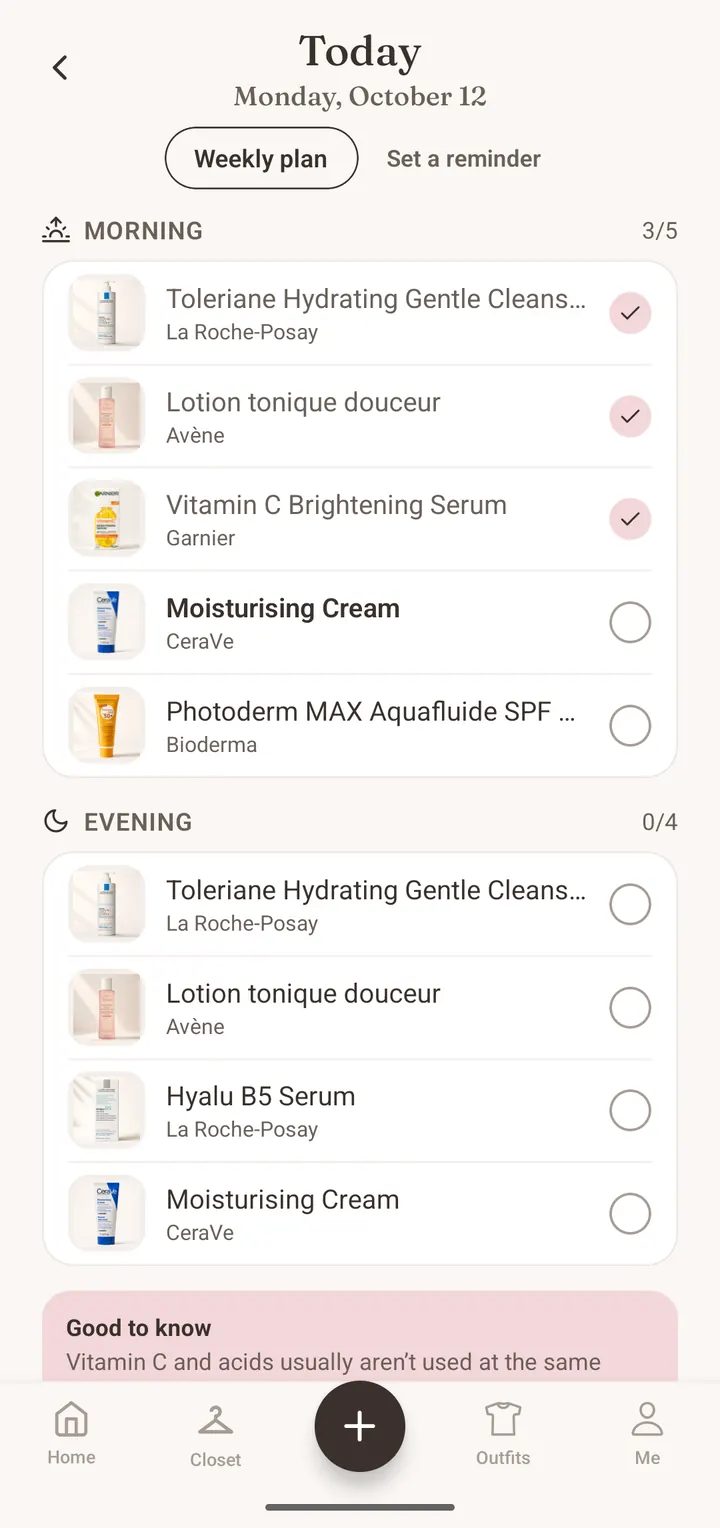
This is where a written plan helps. In Closie Plus, Skincare lets you set how often you use each product, and the weekly plan spreads masks and exfoliants across different days, so your morning and evening steps appear in order next to your outfit for the day. It isn’t a medical tool and doesn’t diagnose anything: it simply organizes the products you already own.
How to organize your skincare with an app →
Common skincare order mistakes
- Applying sunscreen before moisturizer: sunscreen goes last in the morning
- Using two exfoliants plus a retinoid on the same night
- Putting oil under a water-based serum
- Skipping sunscreen on cloudy days or in winter
- Starting several new products at once, so you can’t tell which one caused a reaction
This article is general information, not medical advice. If you have a skin condition, are pregnant or breastfeeding, or use prescription treatments, ask a dermatologist or pharmacist which order and products suit you, and always follow product labels.
What is the correct order to apply skincare?
From thinnest to thickest: cleanser, toner, serum, eye cream, moisturizer, then sunscreen as the last morning step. At night, cleanse, use any treatment, then serum, moisturizer and optional face oil.
Does moisturizer go before or after sunscreen?
Before. Sunscreen is the final skincare step in the morning, applied on top of moisturizer and before makeup.
Should I use serum before or after moisturizer?
Before. Serums are lighter and are meant to go on clean skin; moisturizer goes on top.
Do I need to wait between skincare steps?
Usually only until the previous layer stops feeling wet, often less than a minute. A short pause before sunscreen and makeup helps prevent pilling. Follow any specific waiting time on a product’s label.
Can I use retinol and an exfoliating acid on the same night?
Many people find that irritating, so alternating them on different nights is a common approach. If you want to combine them, ask a dermatologist first.
How the Closie skincare routine app plans your morning and night →
Keep your morning and evening routine in order with Closie Plus
Get Closie Plus