
How to Read Skincare Ingredient Labels (INCI) for Beginners
The front of a skincare bottle is marketing. The ingredient list on the back is the closest thing to facts you’ll get. It looks like a wall of Latin and chemistry, but once you know a handful of rules you can read most labels in under a minute and answer the questions that matter to you: is there fragrance, where does the star ingredient actually sit, and is there anything you’d rather avoid?
The short answer: ingredients are listed from highest to lowest concentration, down to the ingredients present at 1% or less, which can appear in any order. The first five or so ingredients usually make up most of the formula. Names follow INCI, a standardized international naming system, so the same ingredient has the same name on any brand’s label.
What is INCI?
INCI stands for International Nomenclature of Cosmetic Ingredients. It gives each ingredient a standard name, so “Aqua” or “Water” means water everywhere, and “Butyrospermum Parkii Butter” is shea butter whether the jar was made in Paris or Ohio. Plant ingredients use Latin botanical names; many chemical ingredients use names derived from their chemistry.
In the US, the FDA requires cosmetics sold to consumers to list ingredients in descending order of predominance. In the EU, the Cosmetics Regulation requires an ingredient list using common ingredient names (INCI). The core rules are similar, which is why a label from either market reads much the same way.
Rule 1: order tells you roughly how much
Ingredients above 1% must be listed in descending order of concentration. That means:
- The first ingredient (often water) is usually the largest part of the formula
- If a “hero” ingredient appears at the very end, it’s likely present in a small amount, which isn’t automatically bad, since some actives work at low concentrations
- Ingredients at 1% or less can be listed in any order after the rest, so the order at the tail end doesn’t tell you much
- Colorants are often listed at the end, sometimes after “may contain” or “+/-” on products sold in several shades
Rule 2: a label doesn’t show exact percentages
Unless the brand chooses to state it (for example “10% niacinamide”), you won’t know an ingredient’s exact concentration from the list. Order gives you a relative picture, not numbers. And concentration alone doesn’t tell you how well a product works: the form of the ingredient, the pH and the rest of the formula all play a role.
Rule 3: in the US, some products are also drugs
Sunscreens, anti-dandruff shampoos and many acne treatments are regulated as over-the-counter drugs in the US. Their packaging has a Drug Facts panel that lists active ingredients with their percentages (for example zinc oxide or avobenzone), separate from the inactive ingredients. Read that panel first. It’s the most precise information on the pack.
Ingredient groups worth recognizing
Fragrance
Look for “Fragrance” or “Parfum”. Fragrance can be a blend of many components listed under one word. In the EU, certain fragrance allergens (such as linalool, limonene or geraniol) must be named individually when they exceed set thresholds, so you may see them at the end of the list. US labeling rules for fragrance allergens have been under review, so US labels may show less detail. If you’re sensitive to fragrance, also look for essential oils listed by their botanical names.
Alcohols: not all are the same
- Alcohol, Alcohol Denat. or SD Alcohol: drying solvents in some people’s experience, often used for a lightweight feel
- Cetyl, Cetearyl or Stearyl Alcohol: fatty alcohols that soften skin and thicken creams; a different thing entirely
- Benzyl Alcohol: often used as a preservative or as part of fragrance
Humectants and moisturizing ingredients
Glycerin, hyaluronic acid (often listed as sodium hyaluronate), panthenol, urea and propanediol draw or hold water. Butters, oils, squalane, ceramides and dimethicone help reduce water loss and make skin feel softer.
Common actives
- Retinoids: retinol, retinal (retinaldehyde), retinyl palmitate
- Vitamin C: ascorbic acid, sodium ascorbyl phosphate, ascorbyl glucoside, tetrahexyldecyl ascorbate
- AHAs: glycolic acid, lactic acid, mandelic acid
- BHA: salicylic acid
- Niacinamide (vitamin B3)
- Azelaic acid
Preservatives
Any product containing water needs preservation to stay safe after opening. Phenoxyethanol, sodium benzoate, potassium sorbate and ethylhexylglycerin are common. “Preservative-free” products usually rely on special packaging, a waterless formula or a short shelf life.
What an ingredient list can’t tell you
- Whether a product will suit your skin: only patch-testing and use will show that
- Whether the formula is stable, well preserved and in protective packaging
- The exact amount of any ingredient, unless stated
- Whether a claim like “clean”, “natural” or “non-toxic” means anything: these terms have no single regulatory definition
Be cautious with apps or websites that score ingredients as simply “good” or “bad”. The same ingredient can be fine in one product and a problem for one specific person. A more useful approach is to know which ingredients you personally react to or want to avoid, and check for those.
A 60-second label check
- Is it a drug product? If there’s a Drug Facts panel, read the active ingredients first
- Scan the first five ingredients: that’s the base of the formula
- Find the ingredient the front of the pack advertises and note where it sits
- Look for fragrance, essential oils and drying alcohols if you’re sensitive to them
- Check for anything on your personal avoid list
- Look for the PAO symbol or expiration date so you know how long it lasts once opened
What the PAO symbol means and how long products last after opening →
Keeping track of what you avoid
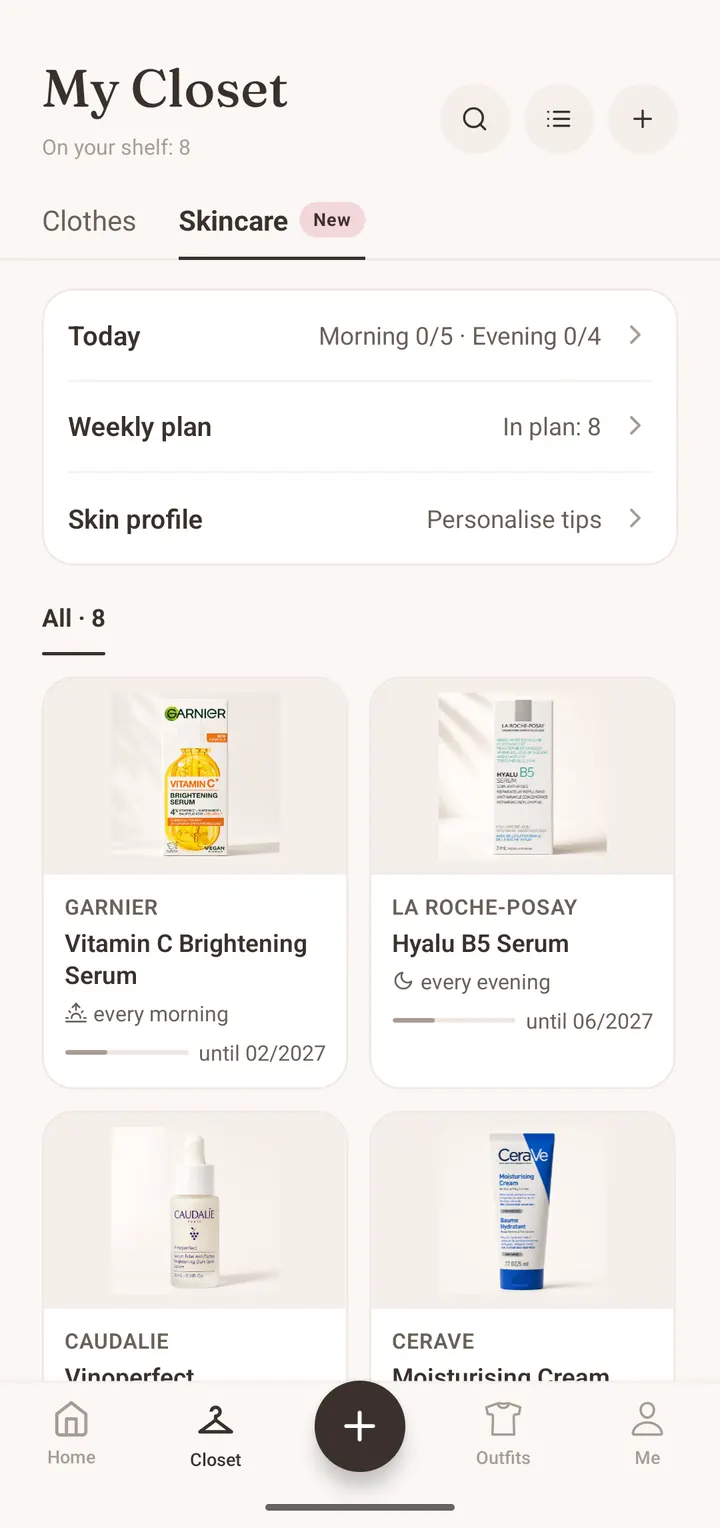
If you know you react to a certain fragrance component or simply prefer to skip an ingredient, checking every new label by hand gets tedious. Closie Plus includes Skincare, where you can add products by scanning the barcode or photographing the packaging. Closie then lists plain facts about the ingredients (for example whether there’s fragrance, alcohol or essential oils, and which actives it contains) without labeling anything as good or bad. You can keep an avoid list on your phone, and Closie flags those ingredients in every list. Closie Skincare is not a medical device and doesn’t tell you what’s safe for your skin; when in doubt, ask a dermatologist or pharmacist.
What does INCI mean on cosmetics?
International Nomenclature of Cosmetic Ingredients: a standardized naming system that gives each cosmetic ingredient the same name on labels worldwide.
Are skincare ingredients listed in order of concentration?
Yes, from highest to lowest for ingredients above 1%. Ingredients at 1% or less can be listed in any order after them.
Why is water the first ingredient in most products?
Because most creams, lotions, serums and cleansers are water-based, so water is the largest component. That’s normal and doesn’t mean the product is “watered down”.
Is “parfum” the same as fragrance?
Yes. Parfum is the INCI term, fragrance is the common US label term. Both can stand for a blend of many components.
Is alcohol in skincare always bad?
No. Fatty alcohols like cetyl or cetearyl alcohol are emollients that soften skin. Denatured alcohol is a different ingredient that some people with dry or sensitive skin prefer to avoid.
How the Closie skincare routine app plans your morning and night →
See the ingredients of every product on your shelf in Closie
Get Closie Plus